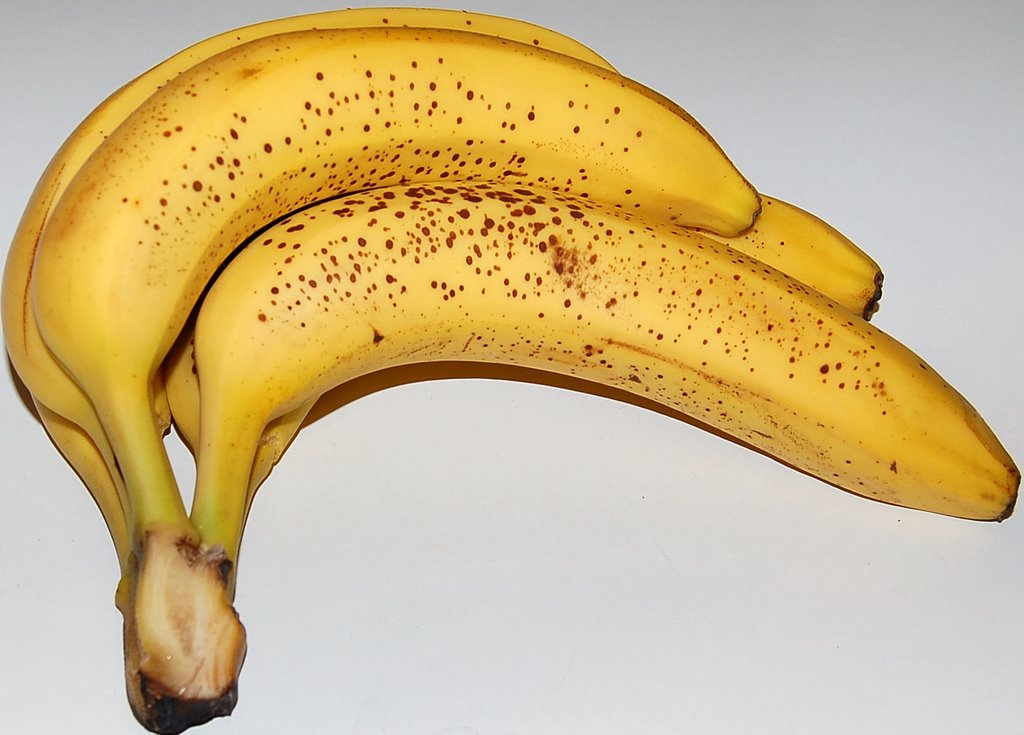
Showing posts with label Malaysian. Show all posts

Thursday, 15 November 2007

Think Spice...Think Ginger

Ginger is one of the most widespread culinary spices. It is also among the most important and valued spices. No one is sure how old ginger is but it is believed to be cultivated for more than 3000 years. Ginger seems to originate from Southern China. Today, it is cultivated all over tropic and subtropical Asia.

This noble condiment comes from a perennial creeping herbaceous plant that produces an erect stem of 30 to 100 cm in height. The stem is surrounded by the sheathing bases of the bright green lance-shaped two-ranked leaves of 15 to 20 cm long, with a prominent longitudinal rib, enclosing conical clusters of a small club-like spike of yellow-green purple-lipped flowers. The gnarled, bumpy root of the ginger plant is the source of this wonderful spice. Although often called “ginger root”, it is actually a rhizome. Rhizomes are knobby thick tuberous underground stems that have pungent and flavourful flesh. The large thick scaly ginger rhizome has a characteristic stag horn-like appearance. It branches with thick thumb-like protrusions, thus individual divisions of the rhizome are known as "hands".

Fresh ginger is available in two forms; young and mature. Young ginger, also known as spring ginger, has a pale, thin skin that does not require peeling. It is very tender and has a milder flavour than its mature form. Mature ginger has a tough tan to brown skin that has to be carefully peeled away to preserve the delicate flesh just beneath it. The flesh ranges from pale greenish yellow to ivory in colour. Ginger has a slightly biting and hot note along with peppery and slightly sweet flavour. Its aroma is rich, sweet, warm, pungent, spicy and woody. Whole raw ginger is generally referred to as fresh ginger. It provides the freshest taste. Ginger also comes in dried form. It is sold either ‘black’ with the skin left on, or ‘white’ with the skin peeled off. The dried ginger is available whole or sliced. Powdered ginger is the buff-coloured ground dried ginger. It has fiery and pungent flavour and has warm, sweet and pungent aroma.


When buying fresh ginger, look for mature plump rhizomes with smooth skin that are not wrinkled. Wrinkled skin indicates that the root is dry and past its prime. It should have a fresh and spicy fragrance. Tightly wrapped fresh unpeeled ginger could be refrigerated in the crisper for up to 3 weeks and frozen for up to 6 months. Dried and powdered ginger must be stored in airtight containers.

Ginger is truly a world domestic remedy. It is most commonly known for its effectiveness as a digestive aid. Ginger has been used in Asia for thousands of years for relief from arthritis, rheumatism, sprains, muscle spasms, catarrh, congestion, coughs, sinusitis, sore throats, diarrhea, colic, cramps, indigestion, loss of appetite, motion sickness, fever, flu, chills, and infectious disease. Its therapeutic properties effectively stimulate circulation of the blood, removing toxins from the body, cleansing the bowels and kidneys, and nourishing the skin. Ginger is also used to treat nausea related to both motion sickness and morning sickness. Other uses for ginger include the treatment of asthma, bronchitis and other respiratory problems by loosening and expelling phlegm from the lungs.

Ginger is extremely versatile. It could be used in any type of food. Ginger is used as a spice throughout the world. In Asian cooking, ginger is almost always used fresh. In savoury dishes, it pairs beautifully with garlic. Dried ginger should be ‘bruised’ by beating it to open the fibres, and then infused in the cooking.

Ginger is my staple spice without which I can never even imagine of cooking. As my entry for the Think Spice Event, I have made one of my favourite Malaysian desserts. This dessert is apt for the climate as it is now continuously snowing in Bern. Originaly this dessert does not call for ginger but I have incorporated it to enhance the taste. I have used both fresh and dried ginger. Actually, both have noticeably different flavours. Therefore, I have used them together in the same dish for a layered flavour.

Gingery Mung Bean Dessert

What do we need:

1/2 cup mung beans
2 cups water
1 cup milk or coconut milk
1/3 cup sugar (or more if desired)
1/4 cup sago
1/2 inch knob ginger, sliced
1/2 tsp ginger powder
2 screw pine leaves, knotted
salt

How do we do it:

Soak the mung beans for about 2 hours and drain.

Combine mung beans, knotted screw pine leaves, ginger and water. Bring to a boil for 20 minutes. Gradually stir in the sago and cook until it is transparent.

Add sugar, salt, ginger powder and milk. Simmer over low heat for 20 minutes or until the beans are soft and the liquid has reduced to half. Remove from heat.


Serve Gingery Mung Bean Dessert warm. The ginger gives a delicate warm flavour to it.


Also check out an amazingly aromatic Ginger Rice.

Sunday, 7 October 2007

Sweetish Reddish Condiment

Recently, I made onion pickle to be served along with murtabak for my daughter’s 3rd birthday party. Traditionally, this pickle is red in colour. So, to keep up to the tradition, I also coloured it RED. Let me share the recipe of this very simple sweet and crunchy pickle.

Onion Pickle

What do we need:

1 large onion
4 tbsp vinegar
4 tsp sugar
1 drop red food colouring (optional)

How do we do it:

In a jar, mix vinegar, sugar and the red food colouring. Stir until the sugar dissolves.

Peel the onion, wash and pat dry. Cut it into half lengthwise and slice very thinly. Place the sliced onion into the vinegar mixture. Set aside.

Within 2 hours the pickle would be ready.


Serve Onion Pickle with murtabak or simply with sambar and rice.

Tuesday, 25 September 2007

Think Spice... Think Mustard

Mustard is one of the oldest, least expensive and most widely used spices. For centuries, it has been used in cooking and as a medicine. Originally, it was the condiment, not the plant that was called mustard.

Mustard is a seed grain. Generally, it is globular, dark brown and just about one mm in diameter. Though mustard does not have any aroma, it has a very sharp and fiery flavour, which is more relevant. Precisely, there are three different kinds of mustard. White mustard is a round hard seed, beige or straw coloured. It is milder in flavour and has good preservative qualities. Black mustard is a round hard seed, varying in colour from dark brown to black, smaller and much more pungent than the white. Brown mustard is the same size as the black mustard, vary in colour from light to dark brown and is more pungent than the white, less than the black.

Mustard Seeds

Mustard seeds are used whole, ground into powder or processed further into prepared mustard. The leaves are used mainly in Chinese and Southeast Asian cooking. Whole seeds are used in pickling. It especially adds piquancy to Sauerkraut and is sometimes used in marinades as well. Mustard is an important spice in Indian cooking for it is the main ingredient used for tempering; the whole seeds are fried until it pops, producing a milder nutty flavour. It is also ground with other spices to prepare curry powders. Mustard oil is piquant oil that may be used in cooking. Powdered mustard is simply finely ground mustard seed that acts as an emulsifier in the preparation of mayonnaise and salad dressings. Mustard seeds could be stored for up to a year in a cool and dry area, away from light. Powdered mustard stays for about 6 months.

Over 4000 years ago, the ancient Greeks believed mustard had been created by Asclepius, the god of healing, as a gift to mankind. Mustard oil is a powerful irritant. It could cause blistering of skin but then, when diluted as a liniment or poultice it soothes and creates a warm sensation. Mustard plasters are used to counter irritants. Mustard has been used for scorpion stings, snake bites, epilepsy, toothache, bruises, stiff neck, rheumatism, colic and respiratory troubles. It is used to induce vomiting and an irritant that draws the blood to the surface of the skin to warm and comfort stiff muscles. Mustard is also used for bathing.

I personally feel that mustard ought to be used more innovatively in cooking. Therefore, here goes my entry for the Think Spice Event.

Mustardy Sweet and Sour Chicken

What do we need:

3 pieces chicken breast

Marinade
1/4 cup tomato ketchup
1 tbsp prepared mustard
1 tbsp ginger and garlic paste
1 tsp tomato paste
1 tsp lemon juice
1 tsp honey
1 tsp salt
1/2 tsp sesame oil

1 carrot
1 celery stick
1/2 red capsicum
1 medium onion
1/2 cup pineapple chunks
1 cup water
2 tbsp oil
1/2 tsp mustard powder
freshly milled pepper
salt

Thickening
1 tsp corn flour
1 tbsp water

How do we do it:

Combine the marinade ingredients. Cut each chicken breast into 6 pieces. Marinade the chicken pieces for at least 30 minutes.

Slice carrot into thin rings. Dice the celery in 1 cm thickness. Cut the capsicum into 1 inch size pieces and quarter the onion.

Fry the marinated chicken pieces in highly heated oil for 2 minutes. Add carrot, celery and water. Simmer until the chicken has cooked. Add capsicum, onion and pineapple chunks. Stir in the mustard powder and season well. Finally, combine the thickening ingredients and stir in. When the sauce starts to thicken, remove from heat.


Serve Mustardy Sweet and Sour Chicken with hot piping rice.

Wednesday, 5 September 2007

A Caramelized Success

I love those little steamed buttery caramel cupcakes sold at the stalls in KL, Malaysia during teatime. I have always wanted to make them by myself. First time tried, it was not so successful. Now, after a year’s gap, tried making them again. This time, it was a great success. Hubby wouldn’t stop eating them. He told me to make another batch for Mahisha's nursery's potluck party the next day. Made them, and everybody liked the cakes as well.

Steamed Caramel Cupcakes

What do we need:

Caramel
1/2 cup sugar
1/3 cup boiling water

1 1/4 cup plain flour
1 tsp baking soda
1/8 tsp salt

1 egg
1/4 cup sugar
1/4 cup melted butter
1/3 cup milk

How do we do it:

Melt the sugar on very low heat. When the colour turns golden brown, immediately remove from heat and pour in the boiling water. Return to the heat and stir until the caramelized sugar dissolves in the water. Remove from heat and cool completely.

Sift together flour, baking soda and salt. Set aside.
Mix cooled caramel syrup, egg, sugar, melted butter and milk. Stir well until sugar dissolves.

Combine the wet ingredients to the sifted flour mixture. Whisk gently until it is lump free. Pour the batter into greased little moulds until 3/4 full. Steam on high for 15 minutes. Let the cupcakes cool.


Monday, 31 July 2006

Jihvā for Ingredients - Flour

Flour is an ingredient used in many foods. It is a fine, powdery foodstuff obtained by grinding and sifting the meal of any of various edible grains or other starchy food sources. It can also be made from legumes and nuts, such as soy, peanuts, almonds, and other tree nuts. Flours are normally identified according to its grain source. A flour can range in texture from coarse to extremely soft and powdery, depending on the degree of bolting (sifting) it receives at the mill.

Flour is always based on the presence of starches, which are complex carbohydrates. Different types of flour are needed for different products. Wheat flour is the main ingredient in most food throughout the world. Rice flour and tapioca starch are more widely used in South East Asian delicacies. Gram flour used mainly used in Indian cooking.

In line with the theme FLOUR, I made a South East Asian delicacy using three different types of flours as its main ingredients. Different flavours and textures of the different flours give a unique taste and texture. I have added alkaline or lye water to give a bouncy or spring back texture to this kuih.

Kuih Kosui

What do we need:

1/2 cup grated palm sugar or brown sugar
1 cup water

2/3 cup rice flour
1/4 cup plain flour
1/4 cup tapioca starch
1/2 cup coconut milk from 1/4 coconut
1 tsp alkaline or lye water

1 cup grated coconut
1/4 tsp salt

How do we do it:

Cook the water and palm sugar until the sugar dissolve. Strain and set aside to cool.

Add the cooled palm sugar syrup to the flours and alkaline water. Mix thoroughly. Strain the batter.

Pour the batter into a greased mould or greased little moulds. Steam on high for 15 minutes. Let the kuih cool.

Meanwhile, mix the grated coconut and salt together. When the kuih has cooled completely, cut into desired shapes and dredge the kuih into the salted coconut.


Kuih Kosui makes a great breakfast or evening tea snack.

Friday, 30 June 2006

From My Rasoi # 6 - For The Love of Rice

Glutinous rice, often called sticky rice is uniquely delicious, tasty and sweet rice. It is starchy and yields attractively sticky, moist, firm and dense rice when cooked. Thus it does a great job of filling the stomach. Glutinous rice can be easily distinguished from other varieties by its short grain and milky colour.


Glutinous Rice


Despite the misleading name, glutinous rice does not contain dietary gluten. Therefore, theoretically it should be safe for gluten-free diets. The sticky consistency of the rice is derived from two kinds of starch in the kernels, namely amylase and amyl pectin.

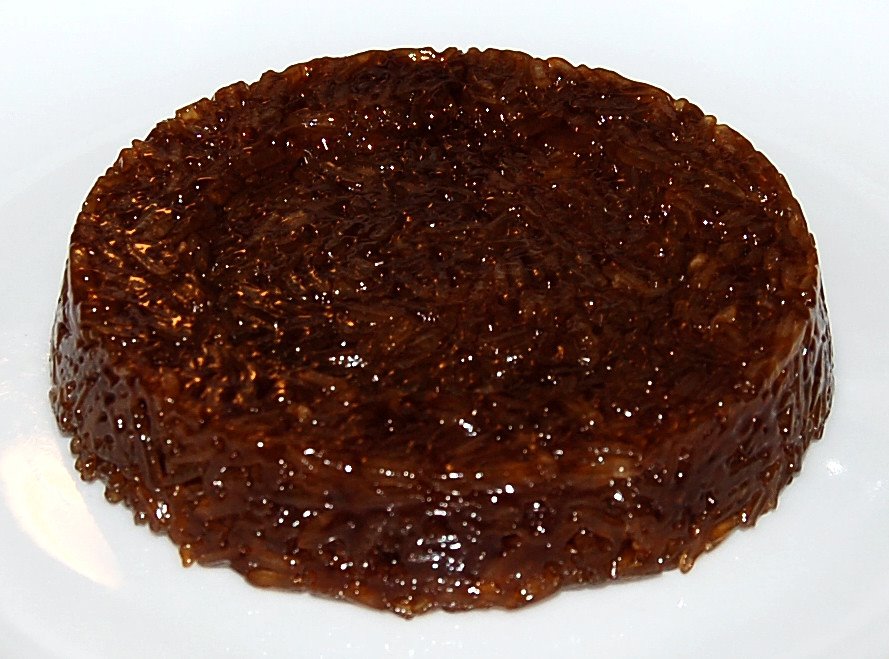
As an entry for FMR # 6 – For The Love Of Rice, I have chosen to make wajik which is steamed glutinous rice braised in palm sugar and coconut milk syrup.

Wajik

What do we need:

1 cup glutinous rice
1 blade pandanus / screw pine leaf
salt

Syrup
1 cup thick coconut milk
1/3 cup palm sugar (as per desired)
2 blades pandan / screw pine leaves

How do we do it:

Wash the rice and soak the rice at least 4 hours. It is important to wash the rice before soaking to ensure that the rice do not break. Drain the rice and mix with salt. Place a knotted screw pine leaf on top of the rice. Steam for 5 minutes or until half cooked. Remove from heat and using a fork, scratch to lossen the rice.


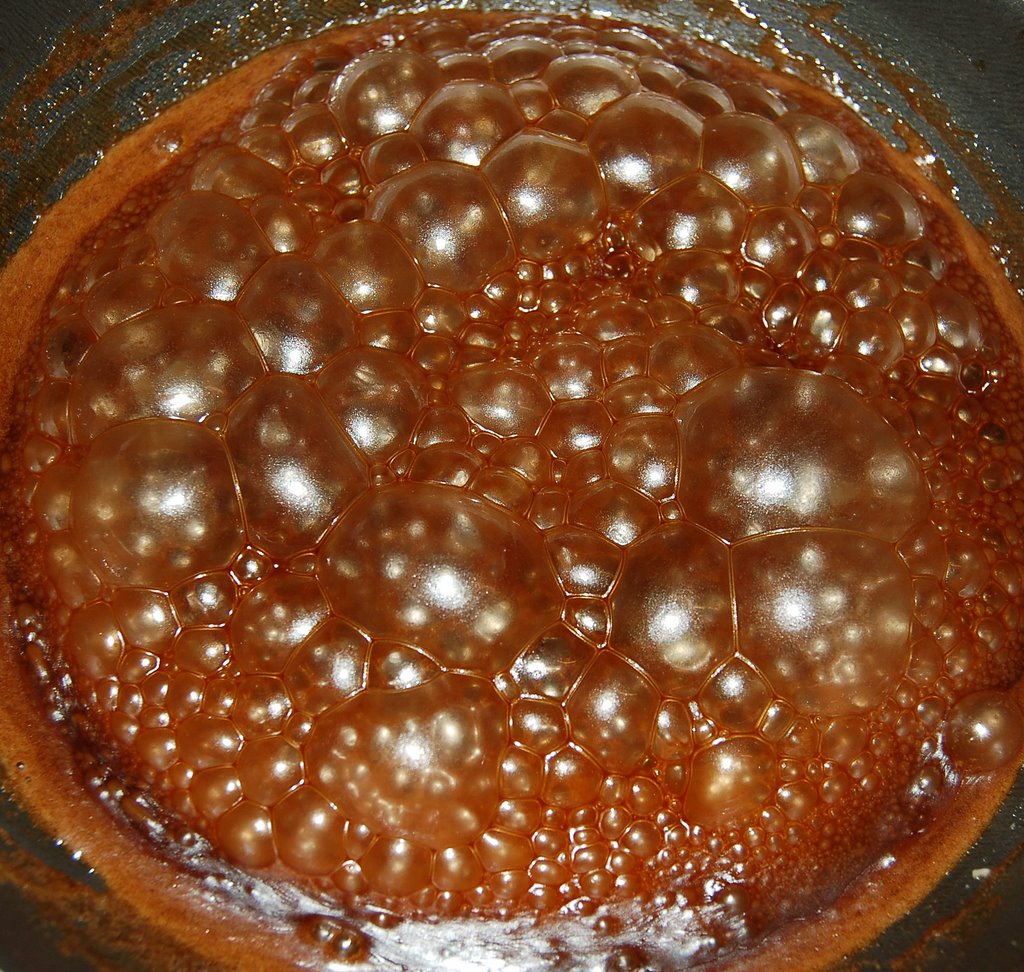
Palm sugar and coconut milk syrup at soft ball stage


In a heavy bottomed pan, boil the coconut milk with palm sugar and knotted screw pine leaves. When the syrup reaches soft ball stage, add the rice. Stir continously to prevent from getting burnt. Remove from heat when the mixture does not stick to the sides of the pan. Discard the pandan leaves. Transfer to a greased mould. Cool completely before cutting into desired shapes.


Wednesday, 7 June 2006

The Food That I'd Die For # 6

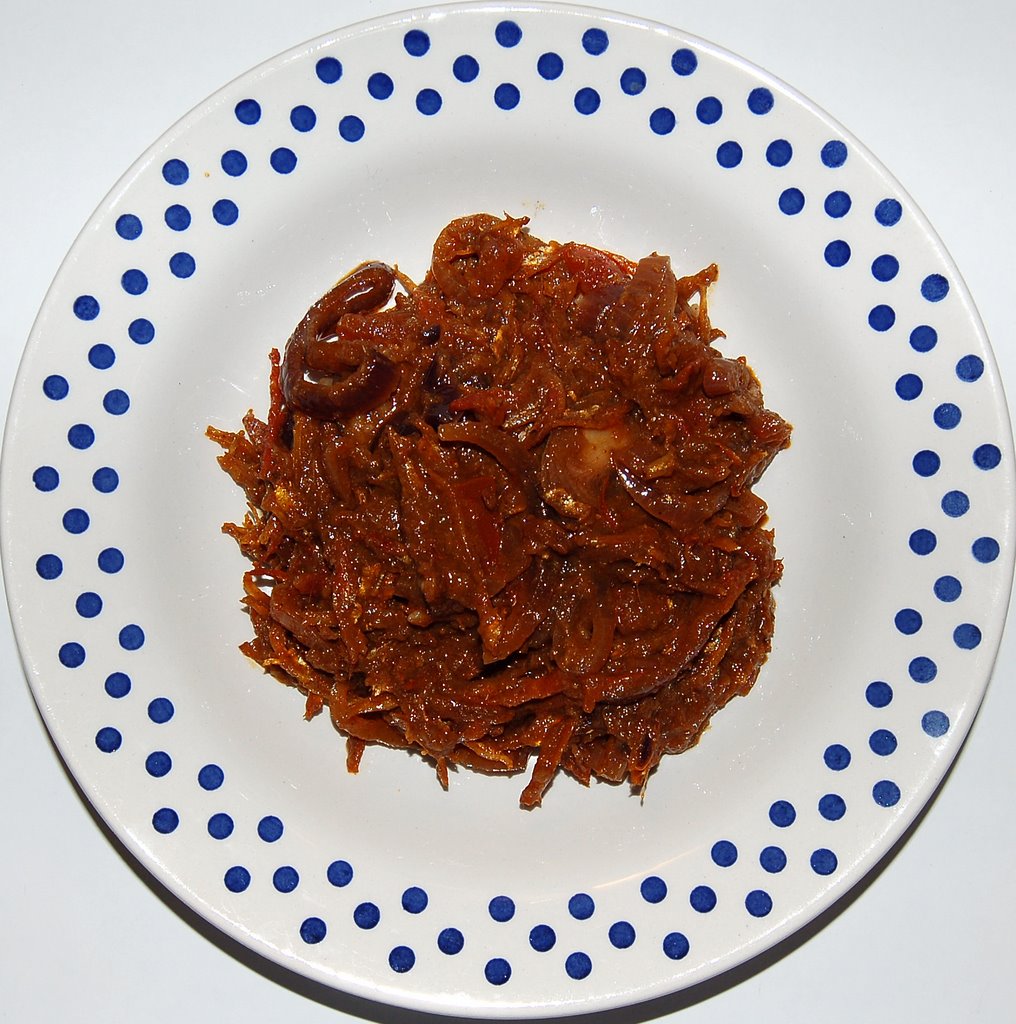
I have been craving for sambal ikan bilis or anchovies sambal. Sambal is a popular accompaniment either as a condiment or as a side dish cooked in Malaysia, Singapore and Indonesia. Sambal ranges in hotness from mildly sharp to incendiary. Belacan or shrimp paste is an essential ingredient in sambal. It enhances the taste of sambal. Tamarind gives a citrus tang. A touch of sugar boosts up the taste of sambal and suppresses the hotness. Sambal is a uniquely delicious and goes well with any food.

Anchovies Sambal

What do we need:

2 cups anchovies
1 big tomatoe
4 dried chilies
2 big onions
3 garlic
1/2 inch ginger
1/2 tsp belacan granules
1 tsp tamarind
1/2 cup water
1/2 tsp sugar
salt

How do we do it:

Peel, wash and drain the anchovies. Set aside.

Combine water and tamarind to prepare the tamarind juice. Set aside.

Grind 1 onion, the garlic, ginger, dried chilies and belacan into coarse paste. Heat oil and fry the ground paste until it is very aromatic the oil rises on top. Pour in the tamarind juice. Add the anchovies. Fry for a while. Add chopped tomatoe and thickly sliced onion rings. Season with sugar and salt.


Anchovies sambal with rice, stir-fried vegetables and baked potatoe wedges.

Serve hot with rice, roti, bread, thosai or idli. I just love it with idlis.

Wednesday, 10 May 2006

The Food That I'd Die For # 5

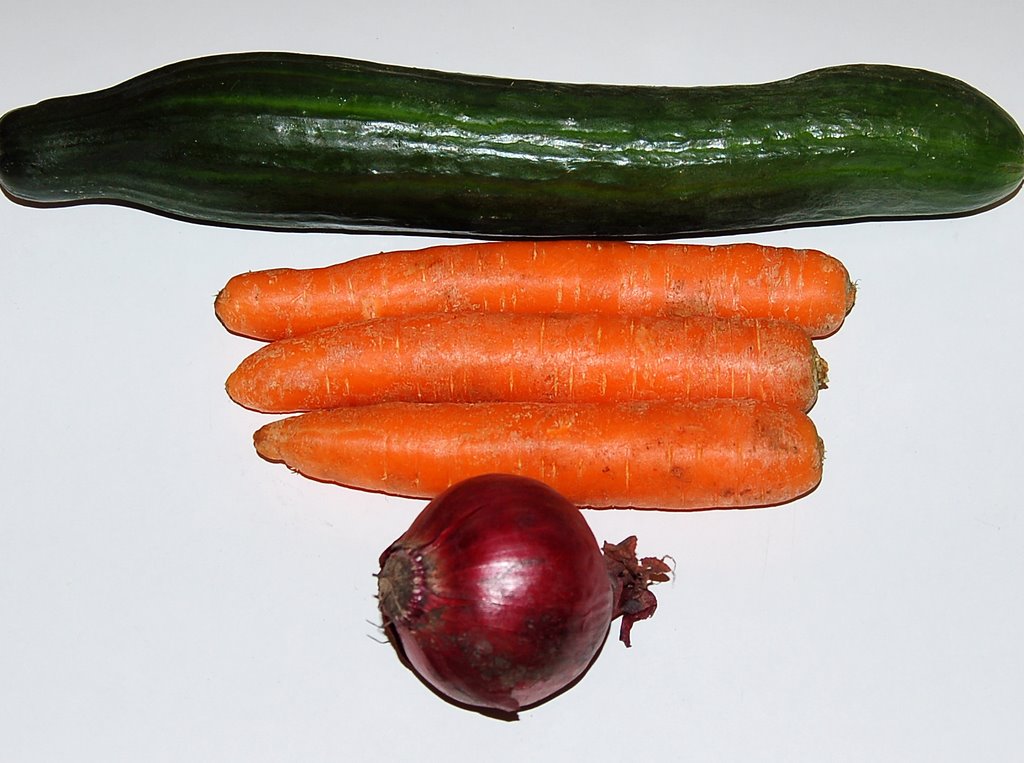
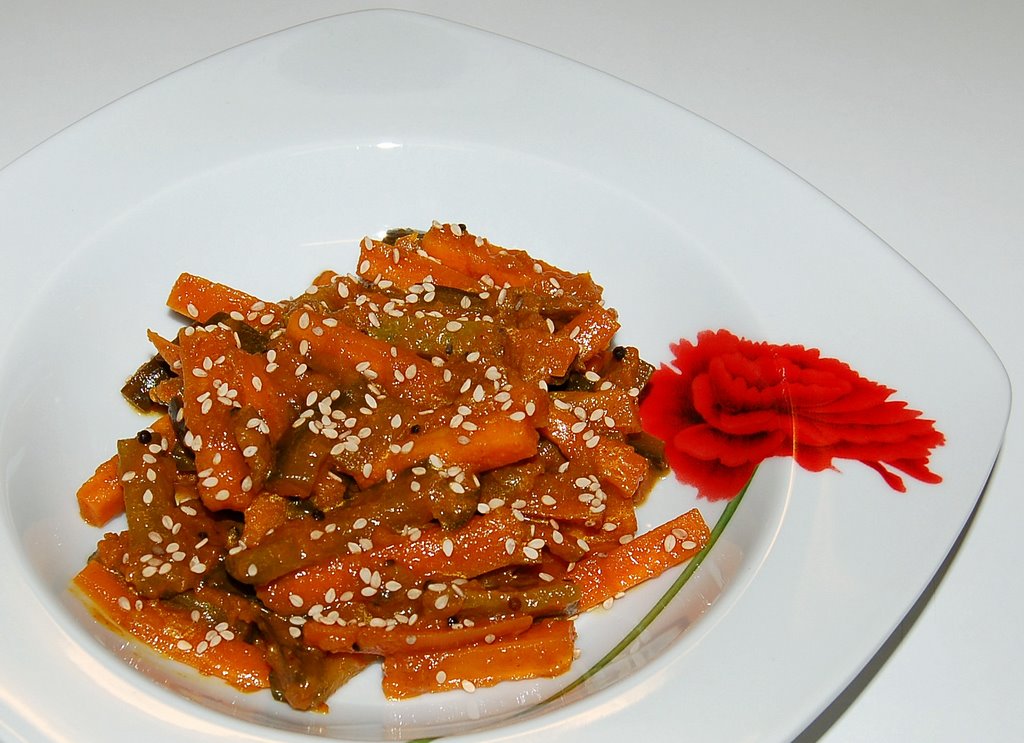
Acar is a Malaysian spicy pickled crunchy salad that is commonly served as condiment or relish to be eaten with a main course. It is sort of a must have item in the food served in Indian & Malay weddings in Malaysia.

Acar is made from different kinds of hard vegetables such long beans, carrots, cucumbers, cauliflowers and cabbage which are pickled in vinegar. The vegetables are then tossed with toasted sesame seeds or ground peanuts.

Acar

What do we need:


1 cucumber
3 small carrots
10 shallots or 1 large onion
2 tbsp sugar
1 tsp salt
1/2 tsp turmeric powder

4 shallots
5 dried chilies
1 tsp mustard seeds
1/2 cup vinegar
1/2 cup water
oil

1 tbsp sesame seeds, toasted

How do we do it:

Remove centre of cucumber and cut crosswise the cucumber and carrots. Then cut lengthwise into about 3cm sticks. Peel the shallots and leave them whole. If using big onion, cut into wedges. Mix with sugar, salt and turmeric. Leave aside for 1 hour.

Snip and soak the dried chillies in some water for a while. Drain off the water and grind together with the shallots.

Heat oil and fry mustard seed until it pops. Add the ground ingredients. Fry until the oil rises. Stir in vinegar and water. Let boil for 3 minutes. Turn the stove off. Add the vegetables and immediately turn off the heat. This is to prevent the vegetables from overcooking. Overcooked vegetables led to a soggy acar. Stir well to mix.

Toss with the sesame seeds before serving.


Serve acar with hot rice and kurma or sambar.

Monday, 1 May 2006

Jihvā For Ingredients - Mango

Along with bananas, one of the most commonly eaten fruits in the world is mango. Tell me anyone who hates mango. It is such a divine fruit. No wonder they are called the "food of the Gods". The mango is also known as the "apple of the tropics". The aroma and the taste of this delectable fruit is unimaginable. They are excellent, soft, juicy and with a delicious, aromatic flavour. Mangoes are rich in vitamins A, C and D.

Mangoes are eaten raw or ripe. Raw green mangoes are pickled or made into salads, chutneys, rojak or just eaten with salt. Ripe mangoes exceedingly juicy and exotically sweet and tart. They are blended into juice, whipped up with yoghurt into luscious lassi. Ripe manoes are made into numerous scrumptious desserts or eaten just as a fruit.

As an entry to "Jihvā For Ingredients - Mango " event hosted by Indra of Mahanandi, I have thought of making a special dessert. It is a fusion of a Thai and a Malay dessert. Steamed glutinous rice topped with mango custard layer.

Kuih Seri Mangga (Mango & Glutinous Rice Dessert)

What do we need:


1/2 cup glutinous rice
1/2 cup coconut milk
1/2 tsp salt
2 screw pine leaves or 1 drop of screw pine essence


1 ripe mango
1 egg
4 tbsp plain flour
3-4 tbsp sugar (adjust with the sweetness of the mango)
1/4 tsp salt
1 drop mango essence

How do we do it:

Wash and soak the glutinous rice for about 4 hours. Drain the water and mix the rice with the coconut milk, salt and the leaves or essence in a pan. Steam for 15 minutes.

Peel and cut the mango. In a blender, combine mango, egg, flour, sugar, salt and essence. Process until the mixture becomes smooth.

Scratch cooked rice with a fork. Pour the mango batter on top of the rice. Steam it again for another 15 minutes.

Cool completely before cutting into desired shapes.


Tuesday, 18 April 2006

The Food That I'd Die For # 4

Talk about Malaysian food, one of the topper would be mamak food. The Indian Muslims in Malaysia are fondly addressed as Mamak. Mamak food are very famous in Malaysia. Everybody loves them. So do I. To name a few most popular mamak food would be rojak, nasi kandar, roti canai, murtabak, fish head curry and mee goreng mamak. Mee goreng mamak literally means mamak style fried noodles. It is indeed very rich in taste.

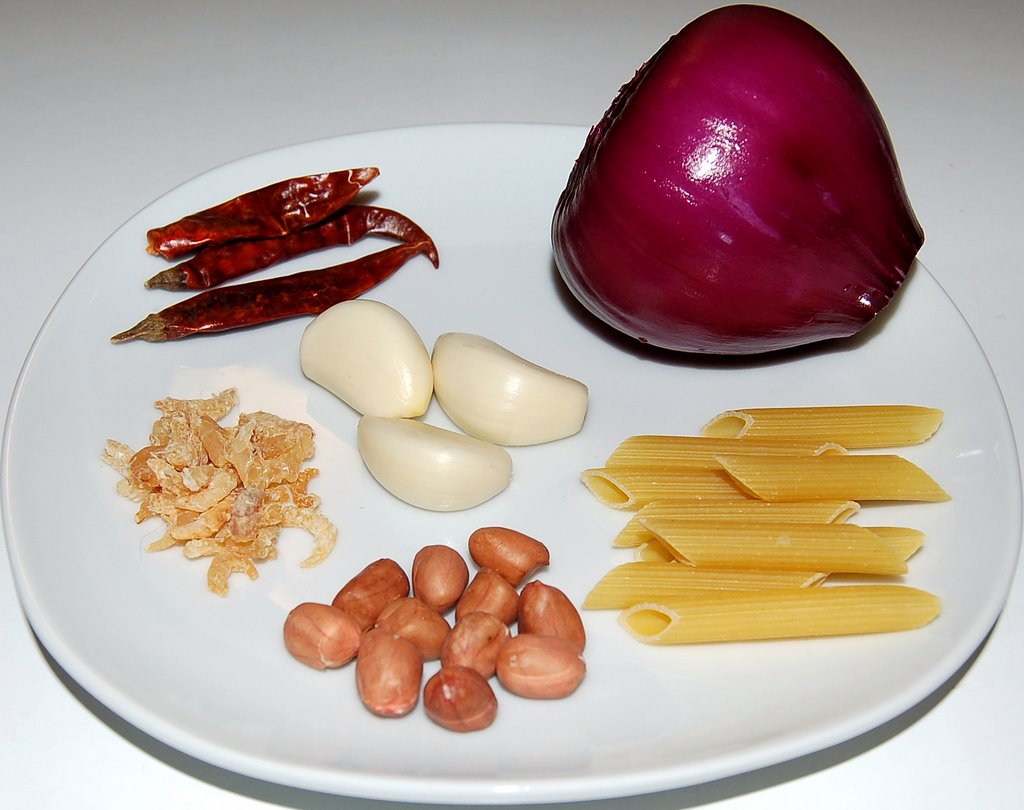
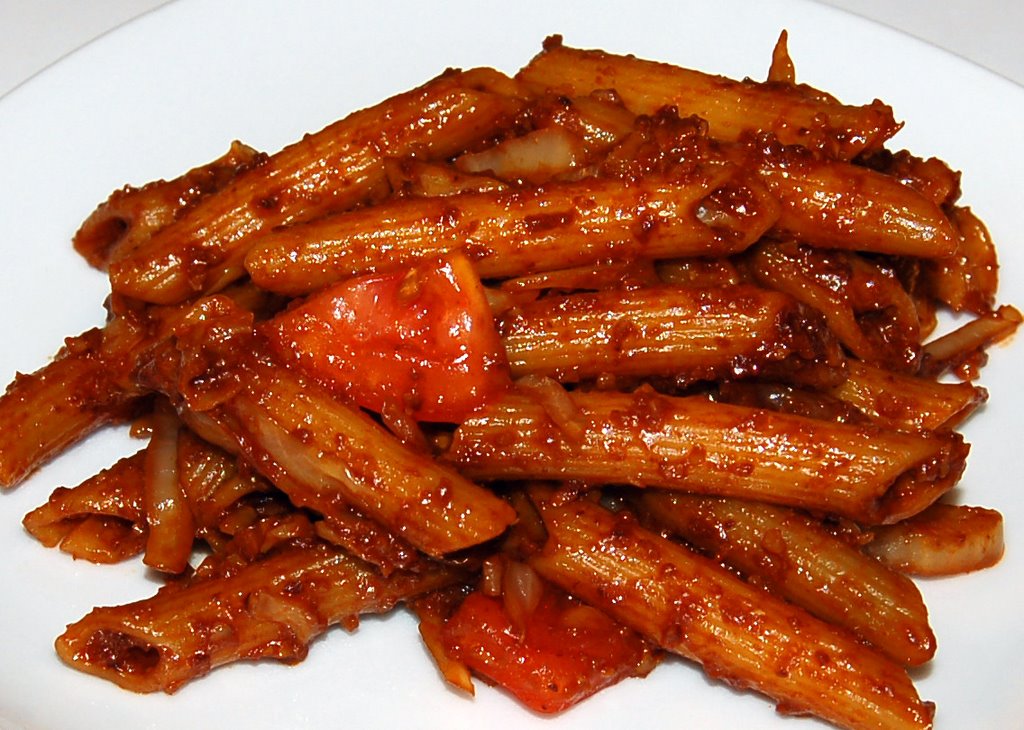
To fulfill my crave for the mee goreng mamak, I tried whipping it up by myself. As the normally used wet yellow noodles are unavailable here, I tried to innovate mee goreng mamak to pasta goreng mamak. Just substituted the noodles with pasta.

Pasta Goreng Mamak (Mamak Style Fried Pasta)


What do we need:


3 cups penne or any other pasta
1 1/2 cup bean sprouts or shredded cabbage
1 tomato, chopped coarsely
1 large onion
3 cloves garlic
3 dried chillies (depends to the hotness desired)
1/2 cup peanuts
1/4 cup dried shrimps
2 tbsp chilli sauce
2 tbsp soy sauce
1 tbsp tomato ketchup
oil
salt
sugar

How do we do it:

Cook the peanuts with water until soft. Drain and leave to cool. Then, remove the skin and set aside.

Boil a pot full of water with a generous amount of salt. Cook pasta in the boiling water to al dente or until the time specified on the pasta package. When cooked, drain and set aside.

Soak the dried chillies until soft. Grind them with washed dried shrimps, the cooked peanuts, onion and garlic. Heat oil in a wok and fry the ground ingredients. When the oil rises to the top, add the bean sprouts or shredded cabbage.

When the the vegetable has cooked, add the cooked pasta, chopped tomato and the seasonings. Stir thoroughly to mix well. Serve hot with lime wedges.


Wednesday, 29 March 2006

The Root

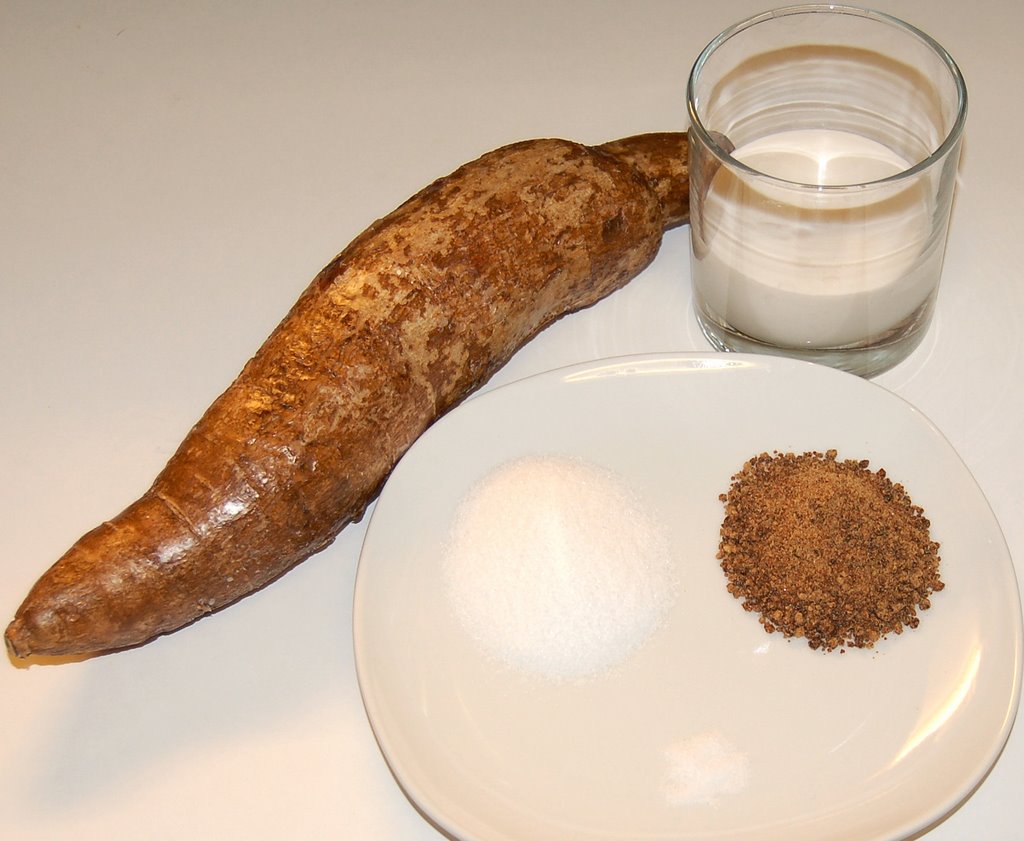
Bought tapioca the other day when I went shopping. Been such a long time since I ate tapioca. It is a very versatile ingredient. Many things can be made out of it, sweet or savoury.

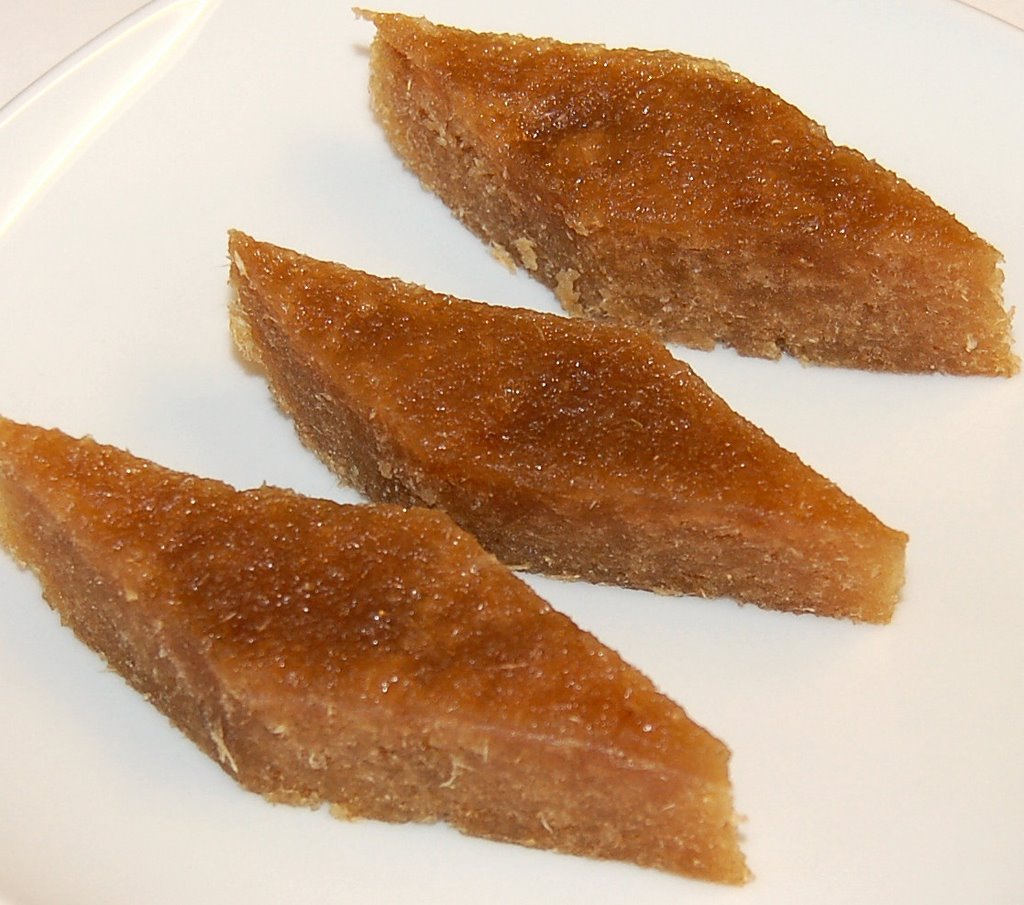
I just love kuih bingka ubi. Have tried making the baked version 4 times. All 4 attempts were failures. Being a person who do not give up that easily, I tried steaming it this time. The result, SUCCESS!!!!

Kuih Bingka Ubi (Tapioca Cake)


What do we need:

500g tapioca
1/4 cup thick coconut milk
3 tbsp palm sugar
2 tbsp white sugar
1/2 tsp salt

How do we do it:

Peel and finely grate the tapioca. Squeeze out the water content in the grated tapioca to get rid of the starch. Would make about 2 cups.


Mix the rest of the ingredients into the tapioca. Transfer the mixture into a greased pan. Steam on high for 30 minutes.

Cool completely before cutting into desired shape.


Bingka Ubi makes great breakfast or tea time snack.

Tuesday, 28 March 2006

The Fashion of Fusion

Fusion is a term which implies the combination of several cuisines in one dish. Fusion at its best allows ingredients from all over to be cooked and served together as a one plate dish.

Being born and bred in a multi-racial country, I literally grew up on fusion food. The food of the 3 main races are always mix matched to create a new hybrid dish or to just upgrade a dish to become more interesting and exciting.

My siblings and I do not fancy curries. My ex-office mates back home used to tease me; "Being an Indian, how could you not like curries?". We do not like anything with curry powder. So, my mom had to be very innovative to create simple food that would attract us. She combines non-indian ingredients and cook them up with an indian touch.

For the FMR-Fusion event at Meenakshi's Hooked On Heat, I am cooking up one of my family's favourite fusion fish dish. This kind of simple food goes very well among us. Everyone of us would have a second helping.

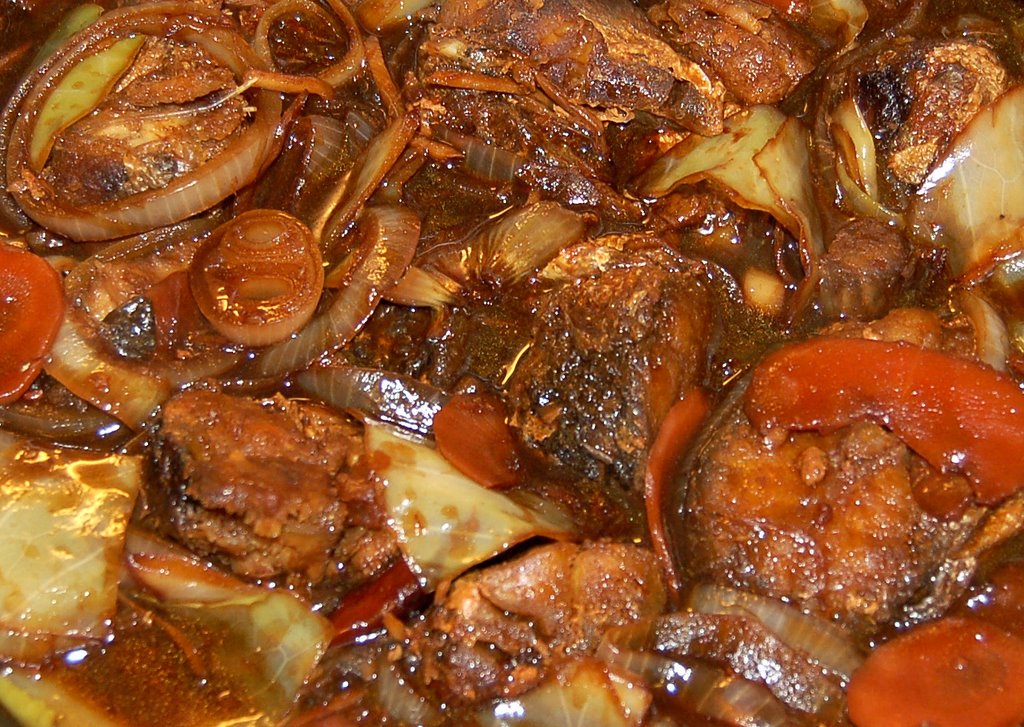
Soya Sauced Fish

What do we need:


500g fish steaks
2 carrots
4 leaves of cabbage
1 onion
2 inches ginger
3 cloves garlic
3 dried chillies
1 cup water
3 tbsp light soy sauce
1 tbsp dark soy sauce
1 tbsp oyster sauce
1/2 tsp turmeric powder
1 tsp sugar
salt
oil

Thickening:
1 tsp corn starch
1 tbsp water

How do we do it:

Cut the cabbage leaves into 1 inch pieces. Slice the carrots diagonally. Slice the onion into thick rings. Julienne the ginger and garlic.

Add salt and turmeric powder to the fish steaks. Heat oil and fry them. Set aside.

In the same pan, reduce the fish fried oil to just 2 tablespoons. Sautè the ginger, garlic and the dried chilles until aromatic. Add the vegetables. Stir to mix. Pour 1 cup of water and cook covered. When the vegetables are almost cooked, add the sauces and season with salt and sugar. Bare in mind that salt has already been added to the fish before frying it and there is high content of salt in soy sauce. Add the corn starch and water mixture. When the sauce starts to thicken, add the fried fishes. Stir gently but thoroughly to ensure all the fish pieces are coated with the sauce. Remove from heat.


Other than cabbage and carrot, any other hard vegetables could be used. French beans is a favourite.


Soy sauced fish best served with hot piping rice.

Monday, 6 March 2006

The Food That I'd Die For # 1

We don't tend to appreciate our home when we are at home. Same goes to food from home. I realised this when I was pregnant. I was craving for only home food. Had to go thru all the hassles of searching for the recipe, looking around for the ingredients and cooking it up. Finally, I wanted to taste only a spoonfull of it. The rest, who else than my hubby who eats them up.

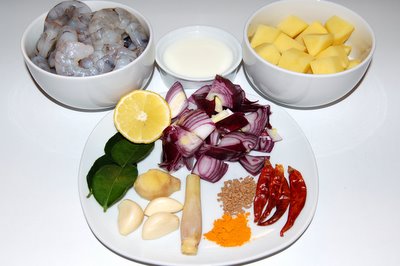
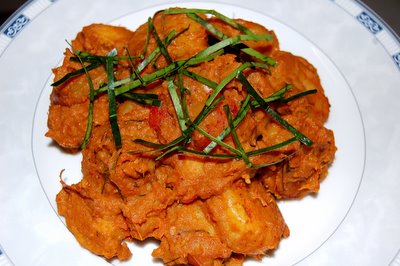
Now, for that past month, I have been wanting to eat prawn sambal. Normally, prawn sambal is cooked with unpeeled prawns. I do not prefer that as it is very troublesome to eat like that though cooking so retains the juices of the prawns. I like it peeled and deveined. Easier to eat. My mom adds fried potatoes to prawn sambal. I love the irresistible taste of the potatoes mixed with the juices of the prawns. In a word, the potatoes taste like prawn.

I am adapting my mom's method of adding the potatoes and I have included some kaffir lime leaves for the citrusy aroma. Also subtituted tamarind juice with lime juice for the extra tanginess. The rest are the normal vital sambal ingredients.

Prawn Sambal


What do we need:

500g prawns
2 potatoes
1/4 cup coconut milk (I used fresh milk)
2 kaffir lime leaves, sliced finely
1 tbsp lime juice
oil
sugar
salt

Sambal Paste:
4 dried chillies (depends to individual)
5 shallots or 1 onion
3 cloves garlic
1 inch fresh turmeric (I substituted with 1 tsp of turmeric powder)
1 inch galangal or blue ginger
1 lemon grass
1/2 tsp belacan granules (shrimp paste)

How do we do it:

Sambal Paste:

Heat a little oil and fry the dried chillies until aromatic. Set aside.

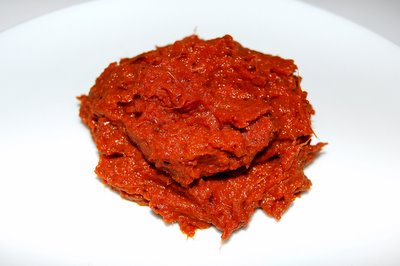
Chop coarsely the onion, garlic, galangal and lemon grass. Pop them into a food processor together with the fried dried chillies, turmeric powder and the belacan granules. Grind until smooth.

Sambal Paste


Prawn Sambal:

Peel and dice the potatoes. Heat oil and fry them until golden brown. Set aside.

Meanwhile, peel and de-vein the prawns. Set aside.

Heat oil and fry the sambal paste until aromatic and the oil separates. Add prawns and lime juice. Stir in the milk and bring to a boil. Cover and cook until prawns turn red. Add the fried potatoes and kaffir lime leaves. Then, season and stir well.


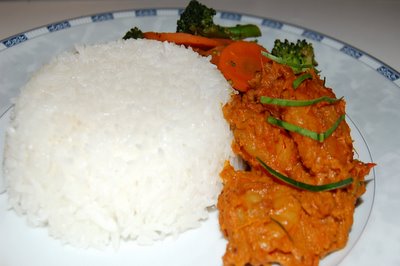
Prawn Sambal with Plain Rice ad Stir Fried Broccoli and Carrot

Serve prawn sambal with hot piping rice.
Related Posts Plugin for WordPress, Blogger...